
C-141 Starlifter: History, Design, and Legacy of the USAF Jet Airlifter

Aircraft Snapshot
The C-141 Starlifter was the first aircraft purpose-built as a jet-powered strategic transport aircraft for the United States Air Force, serving from the mid-1960s through 2006.
-
The C-141A entered service in April 1965. Most airframes were later stretched and refitted as C-141B variants in the late 1970s, and many received further upgrades to C-141C standard with advanced avionics and navigation systems.
-
Core capabilities included four turbofan engines, a rear-loading cargo bay accommodating troops, vehicles, and 463L pallets, with intercontinental range and high speed cruise performance.
-
The C-141 played critical roles in Vietnam (including the famous "Hanoi Taxi" POW repatriation flights), Cold War logistics, Desert Shield/Desert Storm, and numerous humanitarian missions worldwide.
-
The C-17 Globemaster III replaced the Starlifter in Air Force service, but preserved examples, including one at the Air Mobility Command Museum at Dover Air Force Base, keep its legacy accessible to the public.
Introduction to the C-141 Starlifter
In the early 1960s, the US Air Force needed something it had never had before: a major jet aircraft designed from scratch to move army troops rapidly, heavy equipment, and cargo across oceans at jet speed. Lockheed's answer was the C-141 Starlifter, which became the first jet-powered military airlifter designed for military standards and purpose-built for strategic airlift.
The C-141 Starlifter was introduced in 1965 as a strategic military transport aircraft, bridging the gap between slower propeller-driven cargo haulers and the growing demand for rapid global mobility. Its mission was straightforward: serve as a troop and cargo carrier connecting Air Force base locations worldwide, supporting both combat operations and humanitarian efforts.
Three main variants defined the platform's evolution, the C-141A, the stretched C-141B, and the avionics-upgraded C-141C, spanning a service life from 1965 to the type's final retirement in 2006.
Development and Design Origins
The Starlifter originated from a formal requirement issued by the United States Air Force in late 1960, designated SOR-182. The Air Force needed a strategic transport aircraft with global range, high cargo capacity, and the ability to parachute-drop supplies and personnel. Lockheed, Boeing, Douglas, and Convair all competed for the contract.
Lockheed's design, company Model 300, won in March 1961. The first prototype rolled out in August 1963 at the Lockheed plant in Marietta, Georgia, where President John F. Kennedy officially unveiled the aircraft via remote ceremony. The maiden flight followed on December 17, 1963, exactly 60 years after the Wright Brothers' historic achievement.
The design philosophy prioritized utility. The Starlifter featured a T-tail and high-mounted wings for efficient cargo loading, a rear cargo ramp for vehicles and outsized equipment, and a pressurized fuselage that could accommodate both troops and medical litters. Critically, Lockheed engineered the early airframes with structural margin that would allow fuselage stretching and installation of aerial refueling equipment years later, foresight that would prove invaluable.
C-141A: The First Operational Variant
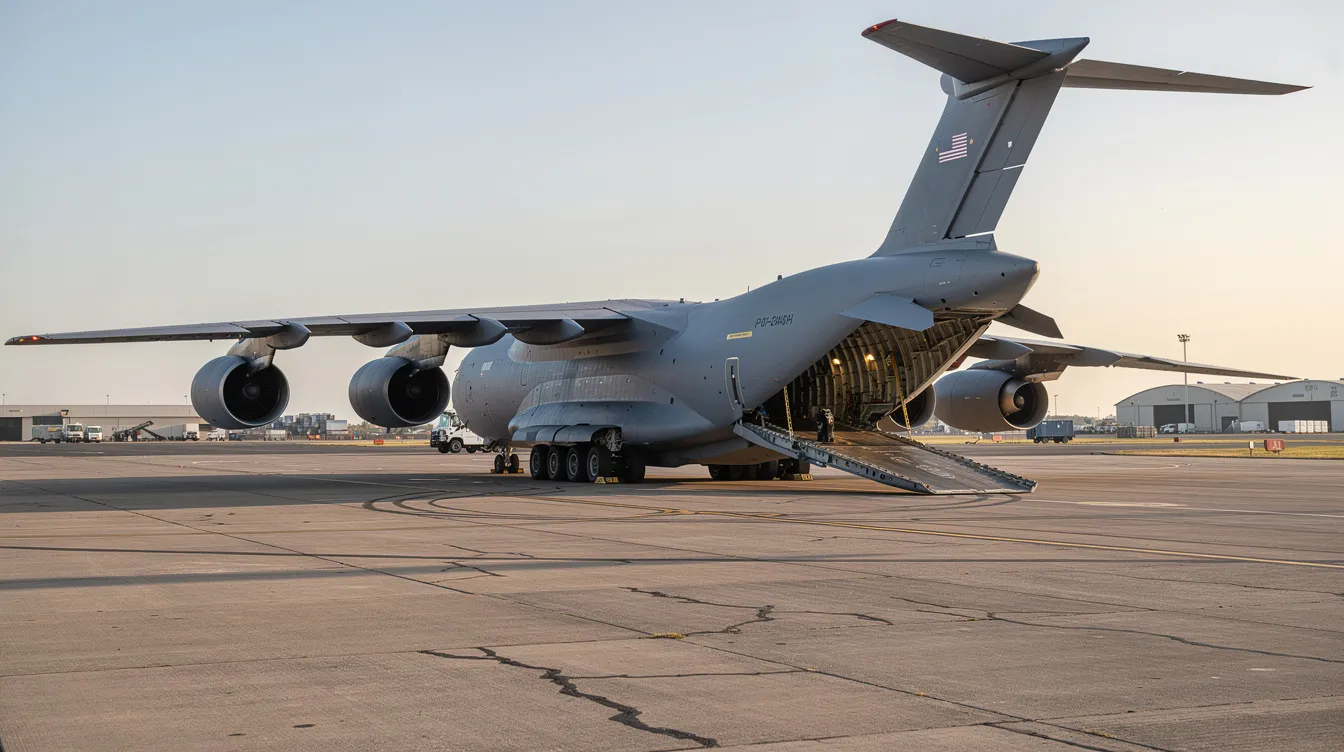
The C-141A completed its first flight in December 1963, with deliveries to the US Air Force beginning in 1964. The C-141A entered service in April 1965, with early operational service at bases including Travis Air Force Base in California. It became the primary aircraft for ferrying troops and equipment globally.
Lockheed produced a total of 285 C-141s, with the C-141A as the initial production configuration. The basic layout included four Pratt & Whitney TF33 turbofan engines, a rear cargo ramp, troop seating along the cargo bay walls, and a conventional four-person flight deck with pilot, co-pilot, navigator, and flight engineer.
The C-141A has a cargo capacity of 62,700 pounds and could transport heavy cargo nearly 4,000 miles without refueling. It served extensively during the Vietnam War, shuttling cargo, medical evacuation patients, and personnel between the continental United States, Pacific bases, and Southeast Asia. The aircraft cut round-trip transit times from California to Saigon from roughly 95 hours (on older transports) to about 34 hours.
However, a key shortcoming emerged during early operational service: the C-141A's internal volume often filled before reaching its weight limit. Many missions were "bulk-limited" rather than weight-limited, meaning the plane flew with unused payload capacity. This limitation set the stage for the modification program that would produce the C-141B.
C-141B and C-141C: Stretching Capability and Service Life
By the late 1970s, the Air Force launched a fleet-wide conversion effort. A total of 270 C-141As were modified to C-141B standard by inserting two fuselage plugs, one forward and one aft of the wings. The result: the C-141B had a fuselage lengthened by 23 feet 4 inches, and Lockheed completed the conversion of nearly all airframes by 1982.
Key improvements in the C-141B included:
-
The C-141B could carry 30% more cargo than C-141A by volume, and its maximum payload rose to 68,725 pounds
-
C-141B modifications added aerial refueling capability via a receptacle on the upper fuselage, giving the fleet great range and nonstop transoceanic reach
-
The USAF lengthened cargo volume from roughly 7,019 cubic feet to approximately 9,190 cubic feet, allowing the fleet to transport larger cargo loads and additional cargo capacity per sortie
The C-141B could fly at a maximum speed of 500 mph, with intercontinental range when supported by tanker aircraft. This added aerial refueling capability transformed the Starlifter into a true global work horse.
Later in their careers, many C-141Bs received C-141C upgrades, which included advanced avionics, digital navigation, traffic collision avoidance systems, and improved component reliability. Approximately 63 aircraft reached C-141C standard. Structural reinforcements, modifications included strengthening the center wing and other critical areas, added extra service life to airframes originally rated for 30,000 flight hours, extending many toward 45,000 hours.

Flight Deck, Crew, and Onboard Layout
The flight deck of the C-141 was arranged with four main seats: pilot, co-pilot, navigator, and flight engineer, plus an additional jump seat for a second flight engineer or observer. The C-141B and C-141C flight deck windows bore a visual resemblance to those on the larger C-5 Galaxy, differing mainly in the center windshield panels.
Each crew member had a distinct role. Pilots managed flight operations and communications. The navigator handled long-range routing, particularly critical on transoceanic missions. The flight engineer monitored and adjusted aircraft systems, engines, fuel distribution, pressurization, and environmental controls, acting as the technical backbone of every mission.
A separate loadmaster and additional crew operated from stations in the cargo bay, not on the flight deck, supporting cargo loading, paratroop operations, and aeromedical missions. On medical evacuation flights, the crew expanded to include flight nurses and medical technicians.
As digital avionics advanced through later modifications and the C-141C upgrade, the traditional flight engineer role became less common on newer aircraft types, highlighting the transitional nature of the C-141's cockpit design between analog and digital eras.
Cargo Bay, 463L Pallets, and Airlift Capability
The cargo bay measures 93 feet 4 inches long and just over 10 feet wide, with a rear-loading ramp and side troop doors. This space was the core of the Starlifter's versatility, allowing rapid reconfiguration between cargo, troop transport, and aeromedical evacuation roles.
The aircraft was compatible with the 463L Material Handling System for efficient loading, carrying up to 13 standard 463L pallets in the B variant. Each pallet, constructed from aluminum and balsa wood, weighing about 290 pounds empty, was secured by nylon nets and tie-downs rated to withstand forces up to approximately 8 Gs during turbulence or combat maneuvers.
Troop accommodations included foldout red webbed benches along the cargo bay walls. The C-141B can carry 205 troops or 168 paratroopers, depending on mission profile. For aeromedical evacuation, the aircraft could carry over 100 medical litters plus attendants in place of standard pallet loads. It was used for aeromedical evacuation, transporting patients from combat zones back to hospitals worldwide.
The ability to carry larger cargo loads, including wheeled vehicles, towed artillery, and outsized equipment, made the Starlifter an indispensable cargo carrier for the Air Force throughout its four decade career.
Troop Doors, Paratroop Operations, and Crew Rest Areas
Two dedicated paratroop doors on either side of the fuselage, located behind the wings, allowed mass parachute jumps by units such as the 82nd Airborne Division. These side doors served a different purpose than the large rear cargo door, which was primarily used for airdropping equipment and vehicles via parachute extraction methods.
C-141B aircraft dropped paratroopers during several major operations:
-
Operation Urgent Fury (Grenada, 1983) - rapid deployment of airborne forces
-
Operation Just Cause (Panama, 1989) - large-scale paratroop insertion
These missions demonstrated the Starlifter's value as more than just a cargo non stop hauler, it was a frontline force projection tool capable of delivering army troops rapidly into contested areas.
The crew rest area, typically cordoned off behind a partition near the flight deck, featured elevated bunks for rotating crews during long intercontinental flights. With the added aerial refueling capability that distinguished the C-141B and C-141C from the original C-141A, nonstop missions across oceans became routine, making crew rest and rotation essential for safe operations.
Operational History and Global Missions
The C-141 participated in nearly every major U.S. military operation from 1965 to the early 2000s, compiling a record that few aircraft can match. It served extensively during the Vietnam War and subsequent military operations, and the aircraft became synonymous with rapid airlift capabilities throughout its service.
Vietnam era (1965–1975): Starlifters flew numerous airlift missions carrying cargo non stop from the continental US to Southeast Asia, supporting sustainment, troop movement, and medical evacuation. In 1973, C-141s flew 422 missions during Operation Nickel Grass, the emergency resupply of Israel, and the C-141 transported 10,754 tons of cargo in 1973 during that effort.
Desert Shield/Desert Storm (1990–1991): The C-141 played a pivotal role in Operation Desert Storm, flying over 7,000 missions. In total, C-141s flew 8,536 airlift missions during Operations Desert Shield and Storm, and C-141s transported 159,462 short tons of cargo in Desert Storm along with over 93,000 passengers.
The C-141 also played a significant role in military humanitarian missions worldwide, including famine relief, disaster response, evacuations from conflict zones, and support after events like Hurricane Katrina. The fleet was based at major hubs, Travis AFB, McChord AFB, Dover, Charleston, and rotated through forward locations in Europe and the Middle East.
The C-141 fleet logged over 10 million flight hours across its service life, and Starlifters logged those hours across four decades of continuous global operations.

Hanoi Taxi and Other Notable Aircraft
The Hanoi Taxi, serial number 66-0177, stands as one of the most historically significant C-141s ever built. This aircraft flew the first group of American prisoners of war out of North Vietnam in February 1973 during Operation Homecoming, a mission that became an enduring symbol of American military power and compassion.
Originally built as a C-141A, the Hanoi Taxi was later stretched to C-141B standard and eventually upgraded to C-141C. Over its career, the plane flew more than 40,000 hours. Before retirement, it was repainted in its 1973 markings to commemorate the POW repatriation flights that made it famous.
In the 2000s, the aircraft also flew missions repatriating remains of fallen service members before the USAF began transferring it to museum status. It was retired to the national museum as a preserved exhibit in 2006.
Several other specific C-141s earned recognition for record set flights, exceptionally high total flight hours, or participation in landmark operations. One record set by a C-141 involved its use as NASA's Kuiper Airborne Observatory, a specially converted NC-141A that conducted infrared astronomy missions until 1995, a testament to the airframe's adaptability beyond purely military roles.
C-141 at the Air Mobility Command Museum and Other Preserved Examples
The Air Mobility Command Museum at Dover Air Force Base in Delaware houses a retired C-141B Starlifter on outdoor display. This aircraft once flew active missions from that same base, making its preservation particularly meaningful.
Visitors can access the aircraft via one of the two troop doors once used by paratroopers, walk through the cargo bay, and see firsthand how pallets and troop seating were arranged. The experience provides tangible context for understanding strategic airlift operations. Admission to the museum is typically free.
Other notable C-141 displays include examples at the Travis Air Force Base heritage center and various outdoor aviation museums across the United States, many located on former Air Force base sites. Air National Guard units and Air Force Reserve facilities have also hosted static displays over the years.
These preserved Starlifters allow visitors to examine details such as the flight deck layout, crew rest area, and cargo bay dimensions that are impossible to appreciate from photographs alone, connecting the public directly to the aircraft's role in strategic airlift history.
Retirement and Replacement by the C-17 Globemaster III
The gradual drawdown of the C-141 fleet began in the 1990s as airframes accumulated fatigue and newer aircraft entered service. The last C-141s were retired from service in 2006, ending a four decade career that spanned the Cold War, Vietnam, and the Global War on Terror.
The Boeing C-17 Globemaster III, produced by what was formerly McDonnell Douglas (now Lockheed Martin's competitor), was chosen as the primary replacement. The C-17 entered service in 1993 and eventually assumed the bulk of strategic and tactical airlift roles. Its advantages over the Starlifter are significant:
|
Feature |
C-141B |
C-17 |
|---|---|---|
|
Max payload |
~68,725 lbs |
~170,900 lbs |
|
Min runway |
~6,000 ft |
~3,500 ft |
|
Core crew |
5 |
3 |
|
Takeoff weight |
~343,000 lbs |
~585,000 lbs |
Lockheed (now Lockheed Martin) and the Air Force publicly praised the C-141's performance during retirement ceremonies, highlighting its record as a first aircraft to respond to conflicts and disasters worldwide. Although surpassed by newer designs in payload and field performance, the C-141 established many of the operational standards that modern airlift fleets still follow, including rapid reconfiguration, palletized cargo systems, and global reach through aerial refueling. Fans of the C-17 can explore our C-17 Globemaster III gifts collection.
Specifications and Performance Overview (C-141B Focus)
The C-141B represented the most widely operated variant of the Starlifter family. Its crew typically consisted of two pilots, a navigator, a flight engineer, and a loadmaster, with additional personnel added for specialized missions such as airdrops or aeromedical evacuation.
Power came from four Pratt & Whitney TF33-P-7 turbofan engines, each producing roughly 20,250 pounds of thrust. This gave the aircraft a maximum speed of 500 mph and a high speed, high-subsonic cruise profile suited for long-range strategic missions. Service ceiling reached approximately 41,000 feet, and ferry range extended to roughly 5,550 nautical miles.
The C-141B can carry up to 68,725 pounds of cargo, accommodate 205 troops or 168 paratroopers, or transport over 100 medical litters with attendants. With aerial refueling capability, the plane could deliver cargo non stop across any ocean, meeting the Air Force's requirement for truly global reach.
These figures varied slightly between the C-141A, C-141B, and C-141C, but all variants shared the same fundamental wingspan of approximately 160 feet, four-engine layout, and T-tail configuration characteristic of the Starlifter family. The takeoff weight for the B model reached roughly 343,000 pounds at maximum capacity, reflecting the aircraft's ability to meet military standards for heavy strategic lift.
Legacy of the C-141 Starlifter
The C-141 Starlifter revolutionized military logistics by enabling rapid global deployment at jet speed and intercontinental scale. The aircraft's design established the modern concept of strategic air mobility, transforming how the Air Force projected power, sustained operations, and responded to crises. Before the Starlifter, no purpose-built jet airlifter existed to carry out these missions at such speed and volume.
Its dual legacy spans combat and humanitarian efforts rapidly delivered across the globe, from Vietnam and the Cold War to disaster relief and medical evacuation operations on every continent. The C-141 also demonstrated that a single airframe design could evolve through stretching and upgrades rather than requiring full replacement, a lesson that influenced procurement strategies for later transports.
C-141 stories, artifacts, and preserved aircraft remain central to Air Force heritage programs and veterans' organizations. The Hanoi Taxi alone represents an emotional touchstone for thousands of families. Understanding this aircraft helps explain today's emphasis on rapid strategic air mobility and the role that current and future transports play in projecting and sustaining American military power worldwide. Those who served with or alongside the Starlifter can find unique aviation gifts that honor that legacy.

Frequently Asked Questions (FAQ)
This section answers common questions about the C-141 Starlifter not fully covered in the main article above.
When did the C-141 first and last fly in US Air Force service?
The prototype C-141 completed its first flight on December 17, 1963, with operational deliveries beginning in 1964–1965 and the C-141A entering service in April 1965. The final official Air Force flights occurred in the mid-2000s, with the last ceremonial retirement flights taking place in 2006. Many aircraft were gradually phased out earlier as the C-17 entered service and individual airframes reached the end of their economic service life.
How many C-141 Starlifters were built and how many survive today?
Lockheed built a total of 285 C-141 aircraft across all variants, the vast majority serving with the US Air Force. While most were eventually scrapped or converted into ground training hulks, a modest number survive as static displays at air museums and former Air Force bases across the United States, including the well-known examples at Dover and Travis.
What made the C-141 different from earlier transports like the C-130?
The C-141 was designed primarily for long-range, high speed strategic airlift between major Air Force bases, whereas the C-130 Hercules is optimized for shorter-range tactical operations and rough-field performance. The Starlifter's jet engines, higher cruise speed of approximately 500 mph, longer unrefueled range of nearly 4,000 miles, and larger pressurized cargo bay made it the preferred platform for intercontinental missions, while the C-130 excelled at operating from austere, unprepared strips that the C-141 could not use.
Could the C-141 land on short or unprepared runways?
The C-141 was designed primarily for use on paved, relatively long runways at established airfields, consistent with its strategic transport role. It required roughly 6,000 feet or more for fully loaded operations. Aircraft like the C-130 and later the C-17, with more robust short- and rough-field capabilities, filled the tactical airlift niche, though the C-141 could still operate into a wide range of standard military air bases worldwide.
Is it possible to fly in a C-141 today?
No C-141s remain in active flying service with the US Air Force, and as of the 2020s, none are known to be airworthy in civilian hands due to cost, complexity, and regulatory limitations. The closest experience available is visiting preserved Starlifters at air museums, such as the C-141B on display at the Air Mobility Command Museum at Dover Air Force Base, where visitors can walk through the flight deck, crew rest area, and cargo bay interiors to get a sense of what it was like aboard this iconic plane.


