
Piper PA-28 Cherokee: History, Design, and Role in Flight Training
The Piper PA-28 Cherokee is one of those aircraft that practically defines what light aircraft look like for a generation of pilots. If you've ever visited a local airfield, chances are you've seen one - a sturdy, low wing, single engine airplane with a purposeful look and a student pilot behind the yoke. This article covers everything you need to know about the PA 28: its development history, key variants, design evolution, operating costs, safety record, and why it remains a cornerstone of flight training and personal flying more than six decades after its first flight.
Flight Facts
-
The Piper PA-28 Cherokee family is an all-metal, low wing, single engine series of light aircraft introduced in 1960 by Piper Aircraft in Vero Beach, Florida. Over 32,000 units have been delivered, making it one of the most produced general aviation aircraft in history.
-
The Cherokee series evolved from early constant chord "Hershey bar" wing models (PA-28-140/150/160/180) to later semi tapered wing variants like the Warrior and Archer, which brought improved cruise speed, climb, and efficiency.
-
Primary missions include flight training (private, instrument, and commercial ratings), personal travel for private owners, and limited air taxi work on short regional routes - not scheduled airline service.
-
This article covers the PA-28's development history, airframe design, wing evolution, major variants, cockpit and avionics progression, operating costs, safety considerations, and lasting legacy in general aviation.
Overview of the Piper PA-28 Cherokee Series
The PA 28 Cherokee series is a family of four-seat, low wing, single engine light aircraft built by Piper Aircraft at its facility in Vero Beach, Florida, since 1960. The designation "PA-28" covers the entire Cherokee family, including well-known names like the Cherokee 140, Cherokee Warrior, Archer, Dakota, and the retractable-gear Piper Arrow - all sharing a common airframe concept and Lycoming piston engines ranging from about 140 to 235 horsepower.
The PA-28 typically seats 2 to 4 people depending on the variant, arranged in side-by-side front seats and a rear bench for rear seat passengers. The aircraft uses an all-metal semi-monocoque fuselage, fixed tricycle landing gear on most models, and a traditional flight control configuration with dual yokes and rudder pedals. Over 32,000 Piper PA-28 aircraft have been delivered since production began.
The PA-28 series is commonly used for flight training due to its forgiving flight characteristics, but it also serves widely in personal use and limited air taxi work. Many aviation enthusiasts know it as the low wing alternative to its main rival, the high-wing Cessna 172. Both aircraft fill similar training roles, but the Cherokee's low mounted wings provide different visibility in turns and a slightly more engaging roll feel, while the Cessna offers better overhead sightlines in level flight.

Development History and Timeline
The PA-28 was conceived in the late 1950s as a modern, all-metal replacement for Piper's fabric-covered Tri-Pacer and Colt - and as direct competition to the Cessna 172 and Beech Musketeer. The design team, led by Fred Weick and John Thorp, created an aircraft that prioritized simplicity, durability, and ease of handling for new pilots.
The first PA-28 models were introduced in 1960, with a first flight on January 14 of that year. FAA certification followed, and the PA-28-150 was certified on June 2, 1961, alongside the Cherokee 160. Piper introduced the Cherokee 180 in 1962 for better climb and useful load, followed by the Cherokee 140 in the mid-1960s as a dedicated trainer with lower power.
Late-1960s developments included improved interiors and the arrival of the PA-28R Arrow with retractable landing gear and a constant speed propeller, giving flight schools a platform for complex endorsement training. The fuselage lengthened slightly across several variants during this period.
Then came the major aerodynamic shift. In 1974, Piper switched to a semi-tapered wing design, debuting on the PA-28-151 Cherokee Warrior. This new semi tapered wing replaced the original constant chord rectangular planform and would define later Warriors, Archers, and Arrows for decades.
Corporate history added turbulence. Piper Aircraft declared bankruptcy in 1991 and reorganized in 1995 as the New Piper Aircraft. Despite these challenges, Archer, Warrior, and Arrow production continued into the 2010s and 2020s. The PA-28 has been in continuous production due to its popularity and versatility - a remarkable run spanning over a decade after decade.
Airframe and General Design Features
The PA-28 has a fully metal airframe for increased durability, using riveted, semi-monocoque construction. This design handles the demands of high-utilization flight school fleets well, offering straightforward repair access and standardized maintenance practices that keep costs manageable over thousands of flight hours.
The low wing configuration attaches via a single main spar to the fuselage, providing docile handling and good roll stability. Steel spring main gear legs bolt directly to the wing structure, while the nose gear connects to rudder pedals for ground steering. Most PA-28s use fixed gear, which reduces complexity and maintenance compared with the retractable systems found on Arrow variants. Differential toe brakes allow precise directional control during taxi and landing.
The tail uses a stabilator design - an all-flying tailplane with an anti-servo tab that provides progressive force feedback as deflection increases. This differs from a conventional elevator and gives pilots light but honest pitch control. A trim wheel in the cockpit (and on some models a rudder trim knob) lets pilots fine-tune forces for hands-off flying during cruise.
Controls follow a traditional flight control configuration: dual yokes, push-pull throttle and mixture controls on earlier models, and a throttle quadrant on later models. The PA-28 often features manual flaps which allow pilots to feel flap deployment - typically operated via an overhead crank between the front seats. Flaps on the PA-28 can extend up to 40 degrees. Fuel selection is a simple left/right tank selector.
Cabin layout includes a single passenger door on the right side, a baggage door for the rear compartment, and enough room for two front seats and a rear bench. This single-door arrangement works fine for training purposes but can slow boarding for air taxi operations.
Wing Evolution: From "Hershey Bar" to Semi-Tapered
The PA-28 wing design changed significantly over its production life, and understanding the difference matters for both pilots and buyers.
Early models used a constant-chord rectangular planform wing known as the hershey bar wing - named for its uniform, chocolate-bar shape. Early models used a constant chord "Hershey Bar" wing design, and it appeared on the Cherokee 140, 150, 160, and 180. The hershey bar design simplified manufacturing with uniform rib spacing and reduced production costs. Aerodynamically, these wings stall first at the root, preserving aileron effectiveness near stall and giving student pilots strong roll authority when it matters most. The tradeoff was a relatively short wingspan that limited climb and glide performance.
Piper introduced a semi-tapered wing in 1974 to improve performance, starting with the PA-28-151 Cherokee Warrior. This new wing featured tapered outer panels, enlarged leading edges with more cambered airfoil sections, and built-in wing twist (washout) to prevent tip stall. The cambered airfoil sections and wing twist work together to ensure the wing roots stall before the tips, maintaining safe stall characteristics even with the new planform.

The semi tapered wing brought real improvements: better cruise speed, improved climb rate, and lower fuel burn at cruise power settings. However, tapered wings tend to "float" more during the flare if approach speed is too high, requiring more disciplined speed management from students. Without the washout, the tapered wing would stall outboard first, reducing aileron effectiveness - so the built-in twist is essential to prevent tip stall and maintain safe handling.
Some instructors still prefer the older hershey bar wing for primary training because of its extremely predictable stall behavior. Many schools, however, favor the Warrior and Archer semi-tapered wings for their efficiency and smoother handling.
Cockpit, Avionics, and Human Factors
The PA-28 cockpit has come a long way from the basic instrument panel layouts of the 1960s to the glass cockpits found in today's new-build Archers.
Legacy PA-28s from the 1970s through 1990s typically feature a six-pack arrangement of primary flight instruments, analog engine gauges (oil pressure, cylinder head temperature, RPM), and simple radio stacks with VOR, ILS, and ADF receivers. These setups remain perfectly adequate for VFR and basic IFR training.
The progression to modern avionics brought panel-mounted GPS units like the Garmin GNS 430/530, upgraded autopilots, and transponders with ADS-B Out for regulatory compliance. The aircraft is often used for instrument training with modern avionics, and many older airframes have been retrofitted to full IFR capability.
Current production models like the Archer LX and Archer TX feature Garmin G1000 NXi integrated glass suites, while the Pilot 100/100i series introduced in 2020 offers Garmin G3X Touch and GFC-500 autopilot at a lower price point. The PA-28 is equipped with modern avionics in newer models, often including GPS navigation for advanced instrument training.
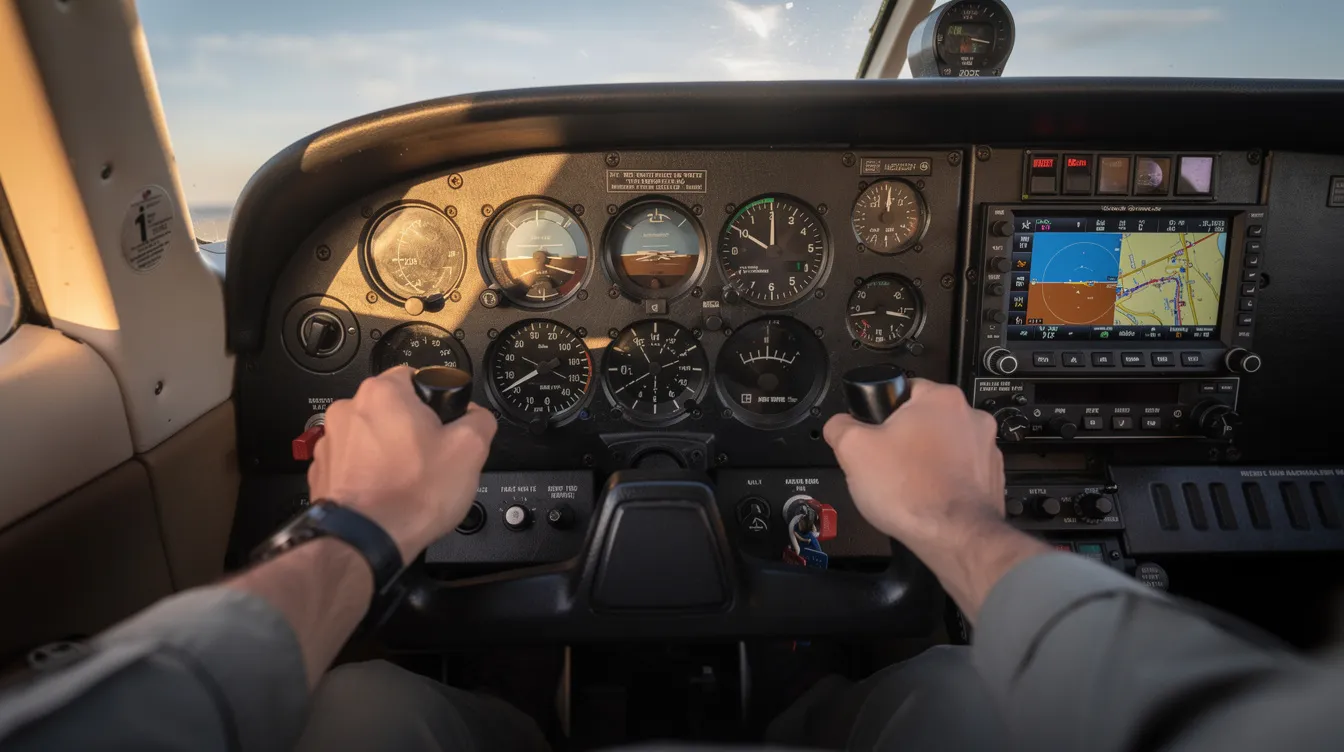
From a human-factors perspective, the PA-28's seating position gives good forward and downward visibility over the cowling and low wing, though overhead views are limited compared to high-wing designs. Flap and trim controls sit in intuitive locations, and the springs acting on the stabilator's anti-servo tab provide consistent pitch feedback. Many pilots appreciate how this layout teaches trim discipline early.
On the used market, avionics configurations vary wildly - and significantly influence purchase price, insurance rates, and suitability for IFR flight training.
Major PA-28 Variants and Their Roles
The term "Cherokee" covers many sub-models, each optimized for different missions. Here's how the core variants break down:
Fixed-gear models:
-
Cherokee 140: The dedicated trainer, powered by a de-rated Lycoming O-320 producing about 140 hp. The PA-28-150 has a gross weight of 2,150 lb, while the 140 is similarly light. Ideal for ab initio private pilot training where performance demands are modest.
-
Cherokee/Archer 180: The popular all-rounder. The PA-28-181 Archer has a power output of 180 hp from a Lycoming O-360, with the PA-28-180 certified with a gross weight of 2,400 lb. Better climb, higher useful load, suitable for both training and cross-country travel.
-
Warrior/Warrior II/Warrior III: 160 hp semi tapered wing trainers, introduced from 1974 onward. These are workhorses at flight schools worldwide, balancing efficiency with honest handling.
-
Dakota/PA-28-236: Approximately 235 hp, offering strong climb and load capability for short fields and hot-and-high conditions. The PA-28-236 Dakota was assembled in Chile with 20 units built for the Chilean Air Force.
Retractable-gear models:
-
The Piper Arrow (PA-28R) series adds retractable landing gear and a constant speed propeller, with 180–200+ hp engines. It's the go-to platform for complex endorsement and commercial pilot training at flight schools everywhere.
International derivatives:
-
Embraer built the EMB-711/712 "Tupi" in Brazil; Chincul produced Archers and Turbo Arrows in Argentina during the 1970s–1990s.
Across the family, average cruise speeds fall between 105 and 135 knots, typical fuel burns range from 8 to 13 US gallons per hour, and useful load accommodates two to four people plus baggage and fuel. The model number and engine choice determine where each variant falls in that range.
The PA-28 in Flight Training and Flight Schools
The Piper PA-28 is widely used for flight training - rivaled mainly by the Cessna 172 as the world's most common trainer. For many pilots, the PA-28 is the first low wing aircraft they ever fly.
Flight schools choose the cherokee series for practical reasons: affordable acquisition, low operating costs, simple fixed gear systems, excellent parts availability, and benign stall characteristics that reduce risk during repetitive training. The PA-28 is suitable for ab initio private pilot training in Cherokee 140 and Warrior models, while Archers handle instrument rating and commercial training with their better performance and IFR-capable avionics. Arrow models serve complex endorsement requirements.

The low wing helps students see and feel bank angle changes during turns, teaching coordination and aileron/rudder use effectively. Whether in hershey bar or tapered wing variants, the PA-28's predictable stall behavior builds confidence. Many large flight schools standardize entire fleets on PA-28 variants to simplify maintenance, reduce parts inventory, and streamline instructor transitions between aircraft.
Many pilots who now fly for airlines started their careers in a Cherokee during training. Thousands of airline pilots logged their first solo, first cross-country, and instrument check rides in PA-28s from the 1960s through the 2020s.
For prospective students: expect a lower seating position than high-wing trainers, good forward visibility, fueling on top of the wing, and entry through a single right-side door. The differences from a Cessna 172 are real but manageable - and many instructors believe exposure to a low wing aircraft early on builds more adaptable pilots.
Operational Uses: Personal Flying and Light Air Taxi
While flight training is the PA-28's bread and butter, many Cherokees spend their lives as privately owned touring aircraft or in small commercial operations.
Common personal flying missions include weekend trips of 200–400 nautical miles, family visits, scenic flights, and experience-building hours through flying clubs. Private owners appreciate the Cherokee's combination of reasonable fuel burn, adequate speed, and straightforward maintenance.
Performance and comfort vary by variant. Archers and Dakotas handle three or four adults with baggage comfortably, while 140 and 150 hp models are best limited to two adults and light bags - especially on warmer days when density altitude reduces climb performance.
For air taxi roles, some Part 135 operators in the US (and equivalent authorities in other countries) use PA-28s for short on-demand hops to smaller airfields, sightseeing flights, and regional legs where turbine aircraft would be uneconomical. However, PA-28s are unpressurized piston-engine aircraft that typically cruise below 10,000 feet. They cannot match the speed, comfort, or all-weather capability of turboprops and jets used in mainstream charter operations. Note that the six seat variant designation applies to the PA-32 Cherokee Six, not the four-seat PA-28 family.
PA-28 ownership or membership in flying clubs can complement commercial travel - many pilots use their Cherokee for regional hops that connect with airline services on longer legs.
Performance, Handling, and Typical Specifications
Performance varies across the Cherokee family, but common characteristics appeal to both new and experienced pilots. Here are representative numbers:
-
Cherokee 140: cruise speed around 105 knots, fuel burn approximately 7–8 gph, typical range around 450 nm with reserves.
-
Archer/Warrior: cruise about 115–125 knots, 9–10 gph, range approximately 550–600 nm.
-
Arrow: cruise 130–140 knots with 10–11 gph, useful for IFR cross-country and advanced training.
General handling is stable in both pitch and roll. Controls feel relatively heavy but honest, rewarding precise inputs without punishing small mistakes. Stall speed varies by variant and configuration, but most PA-28s stall around 46–53 knots with flaps down. The PA-28 offers good crosswind handling due to its wide landing gear design, making it confidence-inspiring on breezy days.
Takeoff and climb traits depend heavily on power-to-weight ratio. Higher-hp PA-28s like the Dakota shine in hot-and-high operations where the Cherokee 140 would struggle. Standard climb speeds of 75–85 knots are taught across most training variants.
Landing characteristics are straightforward. Flight schools commonly teach flap settings of 25–40 degrees for short-field and full-stop landings. Semi-tapered-wing models will float if approach speed is too high, requiring students to be disciplined about maintaining proper airspeed on final. Stabilator effectiveness makes the flare responsive, and later models with the tapered wing need precise speed management through touchdown.
Operating Costs, Ownership, and Maintenance
Cost-effectiveness is a major reason PA-28s dominate both the training and personal ownership markets. The PA-28 family is widely recognized for its low operating and maintenance costs compared to many competing single engine aircraft.
Acquisition costs span a wide range. Older 1960s–1970s Cherokees (140, 150, 160, 180 hp fixed gear) typically sell for $30,000–$100,000 depending on condition, engine time, and avionics. Later models with glass cockpits, upgraded interiors, and fresh engine overhauls command significantly more.
Typical direct operating costs for a Cherokee, Warrior, or Archer run around $67 per hour in variable costs (fuel, maintenance, insurance). Fixed annual costs - hangar, insurance, registration - add $5,000–$12,000 depending on location. Annual inspections are required under FAA Part 91, with higher-utilization training aircraft also requiring 100-hour inspections.
Common maintenance items include:
-
Lycoming engines in PA-28s have a TBO of approximately 2,000 hours
-
Corrosion checks, especially critical on aging airframes - over 11,000 PA-28 airframes are affected by corrosion-related ADs
-
Control cable wear, landing gear leg inspections, and fuel system integrity checks
-
Wing spar inspections mandated by AD 2020-26-16, which applies to 5,440 U.S.-registered PA-28s and requires nondestructive testing of main spar lower caps
Compliance with these Airworthiness Directives directly affects resale value and safety. Many universities, flying clubs, and independent flight schools keep PA-28s in service for decades, rebuilding and upgrading them rather than purchasing brand-new fleets - a testament to the airframe's durability and economic viability.
Safety Record and Training Considerations
The PA-28's safety record compares favorably with other light trainers. Most accidents involve pilot error rather than structural issues. PA-28s average six accidents per 100,000 flight hours, a rate broadly consistent with other popular training aircraft from the 1980s through the early 2000s.
Typical accident scenarios include runway excursions during training landings, fuel mismanagement on longer cross-country flights, and weather-related incidents among less experienced pilots. These patterns reflect pilot decision-making challenges rather than aircraft deficiencies.
The PA-28's stable handling, clear stall cues, and benign spin resistance make it an effective classroom for teaching energy management, decision-making, and IFR procedures. Students learn to recognize approaching stalls through progressive buffet, and the aircraft's behavior near stall limits encourages proper recovery technique.
Structural safety deserves attention, particularly the wing spar fatigue issue. A 2018 accident involving a PA-28R-201 at Embry-Riddle Aeronautical University resulted in an in-flight wing separation caused by fatigue cracking in the main wing spar lower cap. This incident led to updated inspection mandates and reinforced the importance of proper maintenance records, compliance with service bulletins, and thorough pre-purchase inspections for high-time airframes.
The PA-28's lasting legacy as a trusted training platform depends on owners and operators staying current with ADs, maintaining rigorous inspection schedules, and completing regular check rides to keep skills sharp in Cherokee-series aircraft.
The Cherokee Family's Lasting Legacy
The cherokee family has shaped general aviation culture since the early 1960s in ways few other aircraft designs can match. Over 32,000 PA-28 aircraft have been delivered, spreading to flight schools, flying clubs, and private hangars across North America, Europe, Latin America, Asia, and beyond.
The Cherokee occupies a unique position in Piper's lineage. It bridges the gap between earlier tube-and-fabric designs like the Piper Cub and more complex touring and high-performance models. Where the Cub taught an earlier generation to fly, the Cherokee - in its many forms - trained the generation that built modern aviation.
Many pilots feel a genuine emotional connection to the PA-28. It's the aircraft where they completed their first solo, passed a nerve-wracking checkride, or made a memorable cross-country flight that cemented their love of flying. That personal bond, multiplied across tens of thousands of pilots worldwide, is part of why the Cherokee endures.

Looking ahead, refurbished PA-28s equipped with glass cockpits, diesel-powered Archer DX variants, and the Pilot 100 series ensure the Cherokee will remain part of flight training and personal aviation for decades to come. For more posts on aircraft selection and pilot training, the PA-28 story is a natural starting point.
FAQ: Common Questions About the Piper PA-28
This FAQ addresses practical questions not fully covered in the main sections, especially for new students, prospective owners, and anyone evaluating the cherokee series for training purposes or personal use.
Is the Piper PA-28 a good first aircraft for student pilots?
Yes. The PA-28 is widely regarded as an excellent trainer due to its stable handling, simple systems, and forgiving stall characteristics. It is used extensively for PPL and instrument training worldwide, and its benign behavior near stall limits helps students build confidence while learning energy management and coordination.
Whether a student starts in a PA-28 or a high-wing Cessna 172 is often a matter of local flight school fleet availability and instructor preference, not safety. Both aircraft are proven trainers with decades of service. Many pilots who later transition to complex or multi-engine aircraft credit their Cherokee training with giving them a solid foundation.
What is the main difference between a Warrior and an Archer?
Both are PA-28 variants with semi-tapered wings, but they differ in engine power and mission. The Warrior typically uses a 150–160 hp Lycoming engine, while the Archer runs a 180 hp Lycoming O-360, offering better climb and cruise speed along with higher gross weight capacity.
In practice, many flight schools use Warriors as primary trainers for their lower fuel burn and operating costs, while Archers serve as cross-country and IFR training platforms. Archers carry heavier loads more comfortably on longer trips, making them a better fit for private pilots who plan to travel with passengers and baggage.
How does a PA-28 compare to a Cessna 172 for training?
The PA-28's low wing layout provides different visibility than the Cessna 172's high wing. In the Cherokee, you get better downward visibility during banked turns and a clearer view of ground references below, while the C172 offers excellent downward visibility in straight-and-level flight and a different feel during stalls and slow flight.
Performance, safety records, and training value are broadly similar between the two. The choice usually comes down to what the local flight school operates and what a student finds more comfortable. Flying both types during training can make you a more versatile pilot.
Can a Piper PA-28 be used for commercial air taxi flights?
Yes. In many jurisdictions, PA-28s can operate under small-scale air taxi or on-demand commercial rules - such as Part 135 in the US - when properly equipped and maintained. They are generally limited to short regional trips with up to three passengers due to cabin size and performance constraints.
For comfort, speed, and luggage capacity on longer or business-critical flights, operators and passengers typically prefer larger turboprops or jets. The PA-28 fills a niche for economical, short-range missions to smaller airfields where larger aircraft cannot operate efficiently.
What should I look for when buying a used PA-28?
Focus on airframe total time, engine hours since major overhaul, complete logbooks, and avionics fit - especially IFR-capable GPS and ADS-B Out compliance. Documented compliance with major ADs, particularly wing spar inspections, is essential. Ask for records of eddy current or bolt-hole testing on the main spar lower caps.
A thorough pre-purchase inspection by a mechanic experienced with the cherokee series is worth every dollar. Check for corrosion in spar areas and fuselage joints, verify control cable condition, and confirm that the instrument panel meets your intended mission (VFR only vs. full IFR). Well-maintained PA-28s can remain economical and safe for decades of additional service, making them one of the strongest values in general aviation ownership.


